Neighborhood History
IPNA was founded in 1987 by a group of residents who were frustrated that the city seemed to have forgotten this corner of Denver. Calls to city departments were routinely met with the same question: "Are you sure you're in Denver?"
Being tucked against the Sheridan Boulevard county line made the neighborhood easy to overlook. Organizing changed that. Today, staff from city departments attend association meetings, and the neighborhood has a direct line to its City Council office.
The hot topic at the association's founding was the use of Inspiration Point Park. Nearly four decades later, the park is still what most often brings neighbors to a meeting.
Camp Rollandet Natural Area
The acquisition of Camp Rollandet ( 5161 Sheridan Boulevard ) by the City and County of Denver as open space started in 2002 with then District 1 Councilman Dennis Gallagher. The owner at that time was Camp Fire Girls and Boys whose national organization decided to sell the seven undisturbed acres.
Our insightful City Council approved the purchase contract April 19, 2005.
Inspiration Point’s Camp Rollandet Natural Area was dedicated August 24, 2006 with as much pomp as Denver can muster on a Thursday afternoon.
The occasion brought out the mayor, two city council members, a state senator and representative and the city auditor, along with officials and a healthy sprinkling of Inspiration Point neighbors and neighborhood association officers.
It was a celebration of the three-year effort to keep the former Campfire Girls facility from falling to a developer’s bulldozers. The 7-acre parcel at the southwest corner of Sheridan Blvd. and W 52nd St. will be city-owned open space for the foreseeable future.
How much did it cost?
It was first listed it for more than $1 million. The city, working with Great Outdoors Colorado (GOCO), the state organization that distributes Colorado Lottery proceeds for park and open space purchases, was able to buy it for $750,000 -- $400,000 from GOCO and $350,000 from Denver, with $3,100 donated by neighborhood residents.
Where did the name come from?
Camp Rollandet began as a Campfire Girls operation in 1937, when the Kiwanis Club -- a service club like the Rotary or Lions clubs – bought the property and donated it. It was named for the then-regional director of Kiwanis, whose full name has been lost to time. In 1949, Kiwanis built the lodge that still stands, though it was renovated in the late 90s by Campfire USA with a grant that came through then-Mayor Wellington Webb’s office. The renovation included extensive upgrades of mechanical, electrical and sewer service and the construction of office space.
Because of the rich history of the camp and the harmonious relationships that the neighborhood has had with Kiwanis and the Camp Fire organizations, the naming issue became important. Through numerous discussions, the Board decided that it needed to pursue a petition request to keep the Camp Rollendet name.
Susan Baird, then project manager for the Denver Parks and Recreation Department, was instrumental in writing a formal naming ordinance to preserve the Camp Rollandet name and directed the IPNA Board in the legalities of acquiring the three hundred signatures required to keep the name.
Within a matter of weeks, three hundred sixty-four signatures were gathered by IPNA Board members and other concerned residents. This ensured that the name Camp Rollandet was more than an open space, it was part of our neighborhood history that also needed preservation.
Al Martischang & The Martischang Building on 48th and Ames
Al Martischang has the best set of views in Inspiration Point. His house on the hill looks to the mountains from the kitchen table and into downtown from the front room. And if you go up to the window-filled party room that is the second floor, you can take in both of those at once, and Arvada, Westminster and northwest Denver to boot.
Martischang, 93, greets visitors on the front porch on Ames Way, closed in a few years ago so he and his late wife, Fern, could watch the sunrise over the golf course. She died two years ago, and Martischang has turned the front room behind the porch into an office, where he keeps tabs on his properties. The greenhouse on one side used to be filled with the orchids she grew.
He started the house in the 1930s, after he and his wife had moved from Nebraska. At first it was barely larger than two rooms. It was the second house on top of The Point. His neighbor, he said, was the editor and writer George Creel, who had married Blanche Bates. She was an actress known for her role in the play "The Girl of the Golden West," which preceded the opera of the same name. A group of earlier homes along what is now W. 48th Ave. housed workers at Lakeside Amusement Park.
He had mechanical engineering degrees from the University of Nebraska that the government put to use in World War II, when he worked on the construction of the Remington Arms Company's ammunition factories at the Federal Center in what is now Lakewood, and on the Manhattan Project in Los Alamos, N.M., which built the atomic bomb. After the war he worked for an engineering consulting firm before getting into the contracting and development business.
Working for the government hasn't softened his opinion. "Government is a pain in the ass," he said. "I hope you knew that."
He expanded the small house into its present modernistic form in the early '50s, grumbling that people claimed he copied ideas from Frank Lloyd Wright. "I didn't need an architect," he said. "I don't like architects."
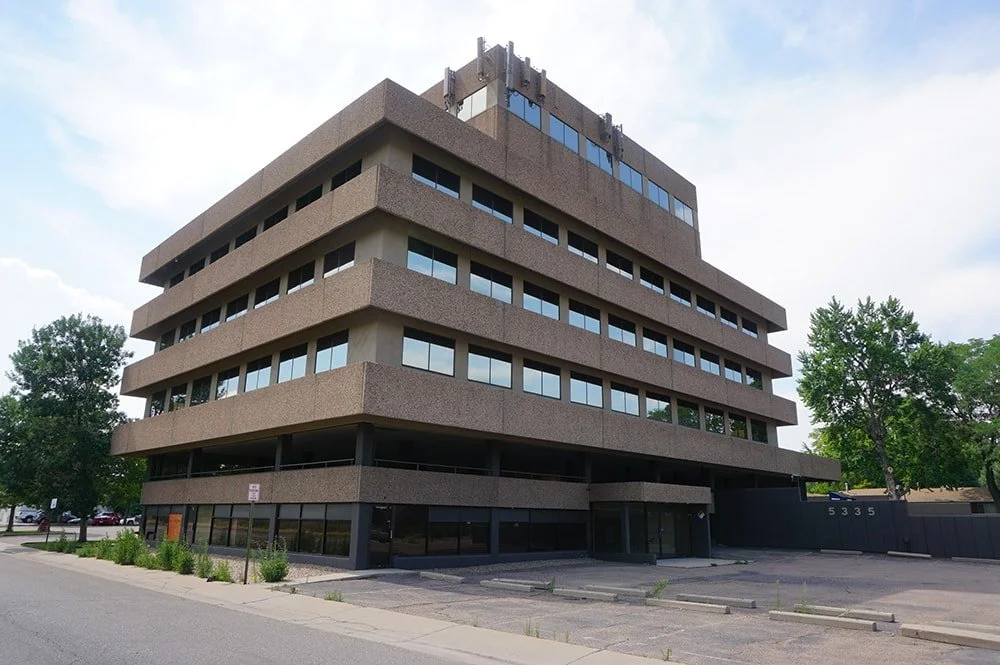
He may be best known for his two office buildings, one at 48th Ave. and Ames St., next to I-70, and another on W. Alameda Ave. in Lakewood. Both proclaim "Martischang" in four-foot letters near their topmost floors. When his wife became ill, he said, "I just locked up the buildings … to take care of her."
And there's the place high on Genesee Mountain, the big log house that looks down on the saucer house. He and Fern spent Christmases up there, with a tree in front of the windows and all of Denver lit up below them. They had no children.
"My doctor told me I had a couple of years left," he said. "But I could get five more if I was mean. And I'm mean."
He's up well before dawn these days and often goes out to check on his properties. "We have a lot of problems with that car wash," he said.
"The problem is," he said, "when you get things just about where you want them, you get old."
Martischang died on November 25, 2008, about a year after this conversation, at 95. He was a working developer to the end.
The office building he put up at 5335 W. 48th Ave., just off Interstate 70 at Sheridan Boulevard, went up in 1976 and still carries his name. It stayed closed and empty for roughly a decade. In October 2014, six years after his death, his family donated the building to the Denver Foundation. The Foundation could not find a tenant or a buyer on its own, and in June 2016 the building sold to Brue Capital for $15.90 per square foot. Brue Baukol Capital Partners planned a major renovation and hired an architecture firm to design it. About a year later, that firm bought the building outright. EVstudio moved into the roughly 41,500-square-foot tower, restored it as its Denver office and an incubator for smaller businesses, and opened a bar on the ground floor.
The man who said he didn't like architects left behind a building that an architecture firm eventually rescued and made its home.
Inspiration Point Park
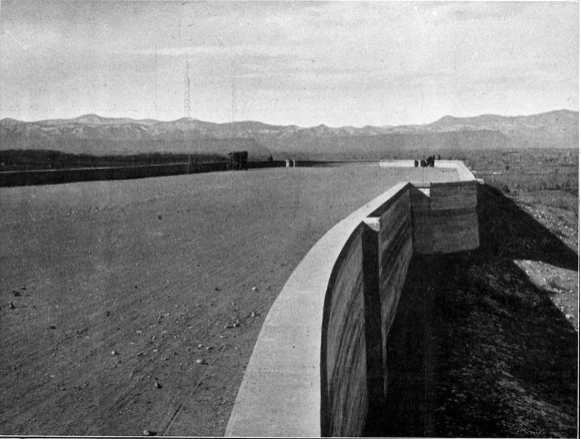
The park predates the neighborhood association by eighty years. Charles Mulford Robinson proposed the site in 1906 as a vista point, and George Kessler included the 25-acre bluff in his 1907 plan for the Denver Park and Parkway System. Kessler and architect Henry Wright completed the park in 1910. The 700-foot concrete retaining wall along the edge of the bluff and the row of ponderosa pines running west from the picnic area both date to that original design.
Inspiration Point Park - Beginnings
By: Amin Mudarres
“I’d be willing to go to jail for it as long as the people of Denver got the use of it.”
-Mayor Robert W. Speer
This is part one in a multi-part chronological history of the Inspiration Point Park for the Inspiration Point Neighborhood Newsletter.
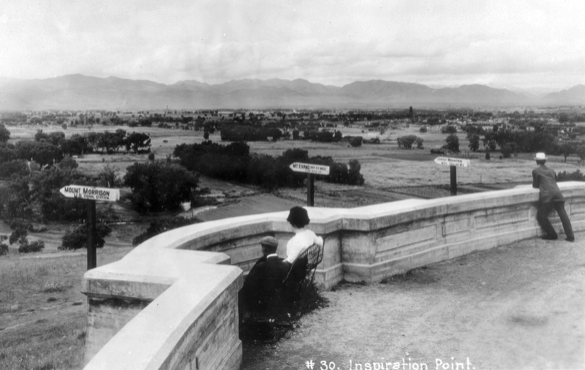
Although the city had no legal right to buy land outside of the city, in 1907 Mayor Speer was already eying our favorite promontory west of what was then city limits. In 1910, he went ahead and acquired the high bluff that was to be “Inspiration Point.” The above-mentioned quote is attributed to him regarding this endeavor (He did not go to jail). The city, acting at the behest of Speer, acquired the the land to settle a tax claim that was close to 8 years in arrears for $8,000.
Famed Landscape Architect George Kessler, designed the viewing area we call “the point” and was instrumental in the land acquisition by the city. Kessler was one of of the most prominent landscape architects in the US at the time, with famous works around the country, most notably Hyde Park in Kansas City and Kessler Park in Dallas, TX. Along with S.R. De Boer and Walter Pesman, a trio was formed that regularly featured in Mayor Speer’s Denver beautification efforts. Pesman was responsible for the "Inspiration Terrace” subdivision along with the stone pillars that mark entrances into the neighborhood which was the subject of last quarter’s newsletter.
The point was formerly known by many names such as Point Sublime, Mountain View Park, Berkeley Outlook, and Look Out Point, before planners settled on the current name.
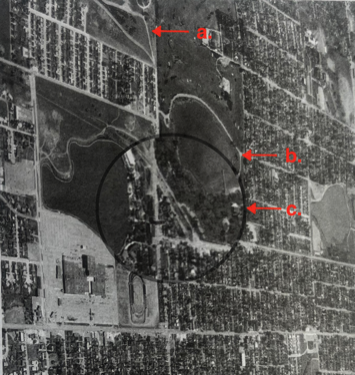
The park was accessible via a diagonal road (Short Yates Street) that connected today’s 46th and Yates with the equivalent of 47th and Sheridan. Today, this most closely falls in the Scheitler Rec Center parking space.
The image to the left shows the park at point a, Berkeley Lake at point b, and a magnified Short Yates Street at point c prior to the arrival of I-70. The development of I-70 through the area in the late 1960’s brought an end to Short Yates Street and portions of Berkeley Lake.
The park was immediately popular with Denver residents and tourists alike. Alongside Short Yates Street was a street car route that continued on to Golden with stops near the park. A “See Denver” street car dedicated 45 minutes for a stop at the park for riders to enjoy the panoramic views. Denver North High School’s ROTC would march up to the park and conduct exercises, sometimes playing games of “King of the Hill.”
In 1944, Inspiration Point was seriously considered to be the first home for the Denver Botanic Gardens (then called The Colorado Forestry and Horticulture Association). The saga was captured in the 1971 edition of the Denver Botanic Garden’s now discontinued publication “The Green Thumb”. As the story is told:
“Various sites were considered. Among these were certain clay pits south of Denver University. Old Overland Park on the Platte River was suggested as a possible war memorial in 1944. Finally, Inspiration Point in North Denver with its 200 acre plot seemed ideal with its superb mountain view, its stream bed and rolling terrain. Assurances of approval of this site by the city were given, indeed, it seemed a “fait accompli.” Alas, to wake one morning and read of another use for this land near Berkeley Park!”
Fortunately for us in the Inspiration Point Neighborhood that other use was to serve as a Denver public park and the namesake of our storied neighborhood.
I have enjoyed being your neighbor for the past 15 years and hope to tell you many more stories as Neighborhood Historian. Please feel free to share your thoughts on this story and ones you wish to hear:
Email: amin.mudarres@gmail.com
In Person: I walk my two dogs daily at the park. Say hello if you recognize the Reddish Shepherd “Boone” and the smaller Pug “Brioche” both usually harnessed to my waist.